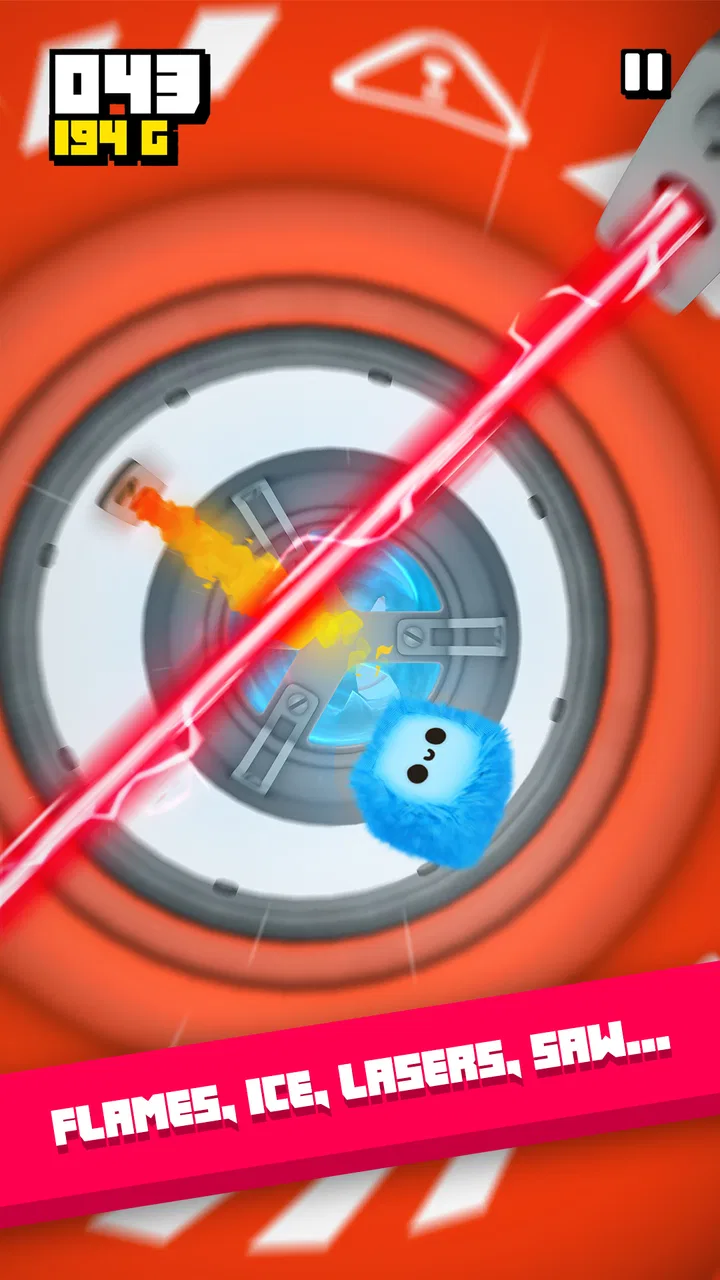
Fluffy Fall
- 4.8
- Rating
- 10.00M
- Installs
- Free
- Price

 Analysis by App-foxy
I first approached Fluffy Fall expecting a quick arcade distraction, and that is exactly where it makes the most sense. You guide a soft, falling character through a stream of hazards, reacting quickly as the run continues. The idea is easy to understand in seconds, but the timing becomes demanding quickly enough to keep short sessions interesting. I found it especially comfortable for those moments when I have only a few minutes and want something active rather than a passive time-killer.
It is a free game from Kilosaurus, listed for Everyone and available on devices running Android 6.0 or later. The current version is 2.4.2, and its long presence on mobile helps explain why it feels like a settled arcade title rather than a rough experiment. It has reached over 10 million installs, with an average rating of 4.8 from around 585,000 ratings. Those figures do not replace personal experience, but they do show that the simple formula has connected with a very large audience.
How the falling challenge feels in everyday play
The central appeal is immediate control. There is no complicated tutorial to study before you understand the objective: keep the character moving safely through danger and survive as long as possible. That makes the game approachable for children, casual players, and anyone who prefers an arcade game that explains itself through play. At the same time, the uncomplicated controls leave little room for excuses when a run ends. Mistakes usually feel like a missed reaction rather than confusion about what the game wanted.
You May Also Like

 Blood Strike: 2.5 Anniversary
Blood Strike’s Loadouts Turn Every Drop Into a Tactical Gamble
A close look at Blood Strike’s custom loadouts: how fast access to signature weapons reshapes its battle royale rhythm, rewards preparation, and narrows the gap between fights.

 Pandora - Music & Podcasts
Pandora’s Music Is Easy to Start, but Harder to Recover
Pandora’s strength is its low-effort path from a seed to a station. Its weak spot is how much confidence it asks you to place in connection, setup, and quiet recovery.

 8 Ball Pool
 Is Built on Rivalries, Rematches, and Routine
A close look at the rivalries, rematches, shared routines, and unanswered safety questions that turn a quick pool match into a persistent mobile community.

 Samsung Music
’s Quiet Strength Is Playing What You Already Own
Its reach comes less from spectacle than from dependable access to a personal library. That simplicity is both the app’s strongest retention engine and its ceiling.

 AccuWeather: Weather Radar
AccuWeather Review: A Quick, Clear Forecast for Everyday Decisions
For everyday plans, the best forecast is the one you can understand quickly. AccuWeather makes rain timing, radar, and local conditions easy to act on, with a few trade-offs.

 Hill Climb Racing
Why Hill Climb Racing Still Turns Crashes Into One More Run
A tiny car, a bumpy hill and one more upgrade: Hill Climb Racing keeps resurfacing because its simple chaos makes every near-miss feel personal.
More From Our News Desk



I think the falling format gives the game a different rhythm from the usual side-scrolling runner. Instead of concentrating only on what is approaching from one direction, I am constantly judging space around a character that is dropping through the screen. That change sounds small, but it affects how I use my eyes and hands. I tend to scan ahead, identify a safe route, and then make a correction before the available space disappears.
A realistic use case is a short commute, a queue, or a break between tasks. I can start a run without committing to a long campaign, and a failed attempt does not create the same frustration as losing progress in a story-driven game. The format also works well when I want to improve a personal result in several small attempts. I do not need a quiet evening or a large block of free time to get something out of it.
The character-collection element gives those attempts an additional purpose. Unlocking different characters adds a light sense of progress beyond simply surviving longer. I would not describe the game as a deep customization experience, but the collectible goal helps prevent each run from feeling completely disposable. For players who enjoy gradually opening visual rewards, that is a useful reason to return.
What makes the arcade loop work
The strongest part of the design is the relationship between simplicity and pressure. A complicated control scheme would get in the way of a game built around fast reactions, while a completely automatic experience would become dull. Here, the basic action is easy to learn, but the demand for accurate movement gives repeated attempts a clear purpose.
One practical tip is to resist making constant, nervous movements. When I react to every small change immediately, I often create a second problem for myself. A better approach is to look for the next safe opening and make a deliberate adjustment toward it. This is one of the less obvious lessons of the game: surviving is not only about speed. It is also about avoiding unnecessary corrections that put the character in a worse position.
Another useful habit is to treat the first part of a run as a reading phase rather than an opportunity to play aggressively. I use those early moments to settle into the movement and notice how hazards are arranged. That makes later decisions less frantic. It is particularly helpful for new players who assume that fast fingers alone will carry them through.
The visual identity also matters. A fluffy character falling through obstacles gives the game a softer personality than a darker survival arcade title. That tone makes it easier to recommend to younger players or to people who do not enjoy harsh-looking action games. The Everyone age rating supports that broad accessibility, although the fast reactions can still be challenging for players who prefer relaxed puzzle games.
How the current version fits the game’s history
The game was released on January 10, 2018, so version 2.4.2 should be viewed as part of an established product rather than a brand-new launch. In my experience, that matters because the underlying concept feels focused. It is not trying to become a platformer, role-playing game, or social hub. Its identity remains tied to quick falling runs, hazard avoidance, and character unlocking.
I would be careful about interpreting the version number as a promise of a particular future direction. A current version tells me which build I am reviewing, but it does not guarantee that the next update will add a major mode or transform the structure. What I can say is that the present release supports the game’s long-running arcade purpose: open it, understand the objective, play a run, and decide whether I want another attempt.
That continuity is good news for returning players who value familiarity. Someone who enjoyed the basic idea years ago is unlikely to be confronted with an entirely different type of game simply because the title has remained available. On the other hand, players hoping for a constantly expanding experience should keep their expectations modest. The appeal is in refining performance within a compact loop, not in following a large evolving adventure.
The developer, Kilosaurus, has kept the title recognizable enough for it to build a substantial audience. With more than 10 million installs and roughly 12,000 written reviews, it is clearly not an obscure one-session experiment. Still, popularity should not be confused with universal fit. Arcade games can attract many people while remaining unsuitable for anyone who dislikes repetition or reaction-based play.
Who will enjoy it, and who should skip it
I would recommend it to players who like endless arcade challenges, quick restarts, and collectible goals that do not require learning a complicated system. It is also a good choice for families looking for a game with an Everyone rating and a friendly presentation. The free entry point makes it easy to try without first deciding whether a longer campaign is worth paying for.
It is less suitable for someone seeking a substantial narrative, strategic planning, or a carefully paced puzzle experience. The game asks for attention and timing, not long-term resource management. If your favorite mobile games are turn-based adventures or construction simulators, the repeated falling runs may feel thin rather than relaxing.
I would also skip it when I am looking for a completely calm way to unwind. The cute presentation can suggest a gentle experience, but the hazards still demand concentration. After a tiring day, I may prefer a game where mistakes do not arrive so quickly. Fluffy Fall is cheerful in appearance, yet it remains an arcade test, and that distinction is important.
Players who dislike free games with optional purchases should also think about their tolerance before installing. The game is free to play, while individual in-app purchases range from $0.99 to $24.99. I would approach the purchase system as optional rather than as a reason to rush through the game. The most sensible way to evaluate it is to play naturally first and decide later whether the available extras genuinely improve your enjoyment.
Small decisions that improve repeated runs
One of my favorite ways to use the game is as a focus reset between demanding tasks. I set a simple boundary: play a few attempts, then stop whether the result is good or bad. That prevents the familiar arcade trap of turning a short break into an endless chase for one better run. Because each attempt is compact, the game works well as a deliberate pause rather than an all-evening commitment.
For beginners, I suggest concentrating on survival before thinking about unlocks. The character rewards are motivating, but chasing them too aggressively can make every decision feel rushed. Once the basic movement becomes familiar, I can start treating each run as practice for a specific skill: reading openings, staying centered, or correcting position without overreacting.
A third insight is that the game rewards learning from the immediate cause of failure. Instead of simply saying that a hazard was too fast, I ask whether I entered the wrong gap, moved too late, or made an unnecessary second adjustment. That short review turns a failed run into useful information. It is a small habit, but it gives the endless format more depth than its simple controls initially suggest.
It is also worth separating visual preference from performance. Unlocking a character can make the game feel fresher, but it does not remove the need to read hazards correctly. I treat the collection as a reason to keep playing, not as a substitute for improving. That keeps expectations realistic and makes the progression feel like a bonus rather than a shortcut.
How it compares with other mobile arcade choices
Compared with a conventional horizontal endless runner, this game places more emphasis on vertical positioning and immediate route reading. Traditional runners often train me to watch the path ahead in a mostly predictable direction, while this falling structure makes the screen feel more like a narrow field that I must navigate through. Players who enjoy runners but want a different spatial challenge may find that change refreshing.
Compared with score-focused arcade games that offer only a leaderboard-style goal, the character-unlocking layer gives this one a more tangible sense of progress. It still depends on repeated attempts, but I have another reason to return when my best result stops improving. The trade-off is that anyone who wants deep progression may find the collection system lighter than the systems in larger games.
Compared with paid premium arcade titles, the free entry makes experimentation easier, but the presence of in-app purchases means the experience is not as straightforward as paying once and forgetting about monetization. That is the main decision point for me. If I value immediate access and do not mind optional purchase prompts, the model is convenient. If I strongly prefer a single upfront price, a premium alternative may feel cleaner.
The rating of 4.8 is impressive, and the large number of ratings gives it more weight than a score based on only a small audience. Even so, I would not use that number to predict whether I will personally enjoy the loop. A high rating can reflect how well the game serves its intended audience, while my own preference may still lean toward slower or more varied gameplay.
Where the experience still has limits
The biggest limitation is repetition. The basic objective is strong enough for short sessions, but it does not offer the variety of a full arcade collection. If I play for too long in one sitting, the same fundamental pattern can begin to feel more like routine than discovery. The game is at its best when I accept it as a focused challenge instead of demanding a constantly changing adventure.
The second limitation is the narrow margin for error. Quick reactions are part of the appeal, yet they can also make the game feel unforgiving. A player with slower reflexes, a small screen, or an unreliable touch response may struggle even after understanding the rules. That does not make the design wrong, but it means the friendly art style should not be mistaken for universally easy gameplay.
The purchase range also deserves a measured response. Free access is useful, but optional spending can change how different players judge the overall value. I would not spend simply because an unlock is available. I would first decide whether I am still enjoying the core runs without turning the game into a chore. If the answer is no, buying more content would not solve the underlying problem.
Another gap is that the game may not satisfy people who need a strong long-term destination. Character unlocking provides motivation, but players who want a story, elaborate missions, or a broad set of systems should look elsewhere. This is a compact arcade experience, and its restraint is both its strength and its boundary.
What I would watch as a player
When deciding whether to keep it installed, I would watch how quickly the repeated runs remain enjoyable after the novelty fades. The important question is not whether the first few attempts are fun; the controls and presentation make that easy. The real test is whether I still want to improve, unlock characters, or practice a particular movement habit after several short sessions.
I would also pay attention to how future versions preserve the balance between accessibility and challenge. The game benefits from being easy to understand, but removing too much difficulty would weaken the arcade loop. Conversely, adding pressure without improving clarity could make the experience frustrating. Any meaningful evolution should protect the readable, quick-start character that makes the title approachable.
For existing users, the current version is best understood as a stable continuation of the original idea rather than a reason to relearn the entire game. New players can begin without historical knowledge, while returning players can come back for familiar short runs. That makes it a dependable choice when I want a small arcade game, even if it is not the title I reach for when I need variety.
My final recommendation is straightforward: try it if you enjoy fast, repeatable challenges and like the idea of unlocking cute characters along the way. The free price removes the main barrier to testing the controls, and the Everyone rating makes it broadly approachable. Just remember that the cheerful look hides a demanding reaction game, and the purchase options mean I would play first before spending anything.
After using it as a quick break game, I see Fluffy Fall as a focused arcade pick rather than an all-purpose mobile favorite. Its best qualities are immediate play, clear goals, and a distinctive falling perspective. Its weaknesses are equally clear: repetition, limited depth compared with larger alternatives, and a challenge level that may not suit relaxed players. If you want a compact game that rewards careful reactions more than long-term planning, it is easy for me to recommend giving it a fair try.
FAQs for Fluffy Fall
01What is Fluffy Fall, and how do you play it?
Fluffy Fall is an engaging endless runner game where players guide adorable fluffy characters through a vibrant and perilous world. The goal is to navigate through obstacles, collect coins, and survive as long as possible. The game’s intuitive swipe controls make it accessible for players of all ages, offering a delightful and challenging experience.
02What are the main features of Fluffy Fall?
Fluffy Fall boasts colorful graphics, smooth controls, and a variety of fluffy characters to unlock and play with. The game features dynamic and ever-changing environments that keep the gameplay fresh. Additionally, players can collect coins to unlock new characters and power-ups, enhancing the overall gameplay experience.
03Is Fluffy Fall free to download and play?
Yes, Fluffy Fall is free to download and play on both Android and iOS devices. While the base game is free, it offers in-app purchases for players who wish to enhance their experience by purchasing coins or special characters. However, these purchases are optional and not necessary to enjoy the game.
04Are there any in-app purchases in Fluffy Fall?
Fluffy Fall includes optional in-app purchases. Players can buy coins to unlock characters and power-ups more quickly. These purchases can enhance the gaming experience but are not required to progress or enjoy the game. It's designed to be fully enjoyable without spending money, making it accessible to all players.
05Does Fluffy Fall require an internet connection to play?
Fluffy Fall does not require a constant internet connection for gameplay, making it a great option for offline play. However, certain features, such as in-app purchases or social sharing, may require an internet connection. This flexibility allows players to enjoy the game anywhere, anytime.
Pros
- Engaging and colorful graphics.
- Simple controls for easy gameplay.
- Variety of characters to unlock.
- Quick sessions perfect for short breaks.
- Regular updates with new features.
Cons
- Can become repetitive over time.
- In-app purchases can be tempting.
- Ads can interrupt gameplay.
- Requires internet for some features.
- Limited offline play options.

Fluffy Fall
Gallery